 Confucius - the Secular as Sacred Herbert Fingarette
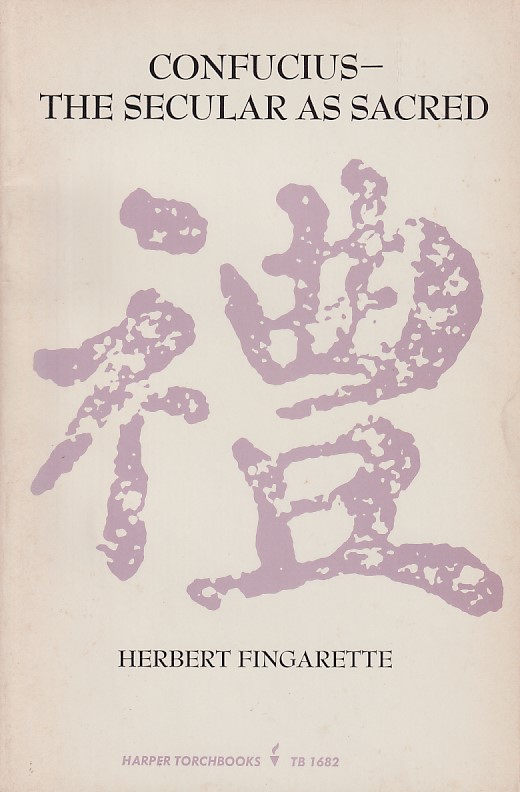
Confucius - the Secular as Sacred
by Herbert Fingarette
¥675
ESSAY: PAPERBACK: (中古) used - acceptable
ENGLISH
Don't be fooled by the nondescript academic looking cover. This is a book for any educated reader. If you have ever thumbed through the Analects by Confucius and wondered why he was by far the most influential thinker in China's history, this book provides the answer.
According to Fingarette, Confucius believed that the characteristics of humans which make us different from animals have an almost magical quality. This quality is most pronounced as it relates to li which is a term similar to holy ritual or sacred ceremony. Li involves respect of others and sublime patterns of behavior for mourning, marrying, fighting, and being a prince, a father, a son and so on. Professor Fingarette describes li as something that captures the essence of what makes us human, and the deep response that li provokes only occurs if the custom or ritual evolved from earlier traditions, it cannot be legislated or mandated: "He who by reanimating the Old can gain knowledge of the New is indeed fit to be called a teacher." New conditions always require that traditions be reanimated, and a successful government, Confucius insists, takes advantage of traditions which raise the civilized above the barbaric: "govern the people by regulations, keep order among them by punishments, and they will evade shamelessly. Govern them by moral force, keep order among them by ritual, and there will be not only shame but correctness." Li makes difficult tasks simple and brings order to chaos: "With correct comportment no commands are necessary, yet affairs proceed."
Fingarette writes that our body of culture makes possible behavior which is distinct from acting on our instincts, or from treating others as animals or objects. The enabling hinge upon which culture rests is li which depends on learned and accepted conventions. These conventions, if they are not to become stale, require an openness and a sharing which leads to more dynamic interrelations and to a heightened community that does not rely on force, threats and commands. Confucius himself made possible a universalistic civilization by expounding on the perfection of the "ancients" whom he always referred to in the most favorable light. The authentic reanimation of tradition, Fingarette writes, is the source of human dignity:
"To be devoted to one's parents is far more than to keep the parents alive physically. To serve and eat in the proper way, with the proper respect and appreciation, in the proper setting - this is to transform the mere nourishment into the human ceremony of dining. ... The shapes of human relationships are not imposed on man, not physically inevitable, not an instinct or reflex. They are rites learned and voluntarily participated in... To `be self-disciplined and ever turning to li' is to be no longer at the mercy of animal needs and demoralizing passion, it is to achieve that freedom in which the human spirit flowers."
- Willis
We have this title in stock at our house in Chitose Hokkaido and can ship it directly to you now.
♥ 5 LIKES
BOOK COVER: The cover is taken from google book search unless otherwise noted.
DISCOUNT: Yes, feel welcomed to ask us for discounts.
 I did not attend his funeral, but I sent a nice letter saying I approved of it. - Mark Twain